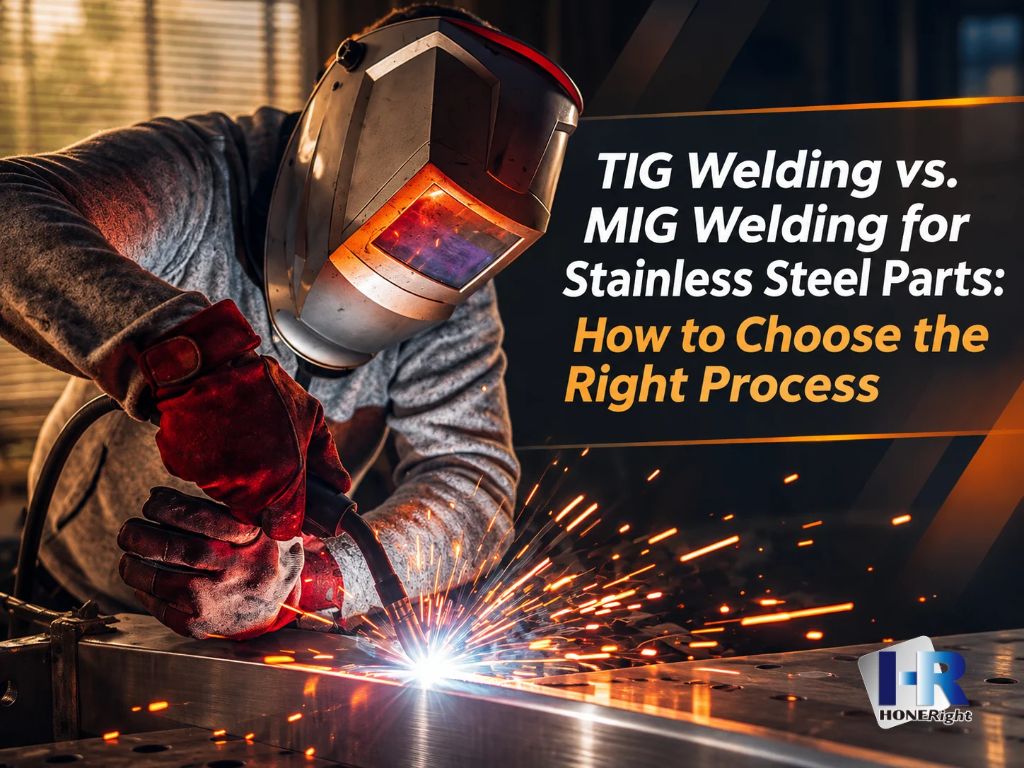
Choosing between TIG welding and MIG welding for stainless steel parts depends on material thickness, joint design, weld appearance, production volume, and dimensional requirements. TIG welding is often preferred for precise joints and clean welds, while MIG welding is generally more efficient for longer weld seams and larger structural assemblies.
For manufacturers, however, welding speed and appearance are only part of the decision. Heat distortion, corrosion resistance, and subsequent machining or grinding can also affect the quality of finished components.
This guide compares TIG and MIG welding, explains when each process is appropriate, and helps manufacturers select a welding solution for stainless steel fabrication and industrial metalworking.
What Is TIG Welding?
TIG welding (Tungsten Inert Gas welding), also known as Gas Tungsten Arc Welding (GTAW), is a welding process that uses a non-consumable tungsten electrode to create an electric arc. Shielding gas, commonly argon, protects the weld area from atmospheric contamination.
Unlike MIG welding, TIG welding allows filler metal to be added separately when required. This provides precise control over weld pool formation and filler deposition.
TIG welding is commonly used for stainless steel components requiring accurate weld placement, controlled weld geometry, and clean surface appearance.
Key Advantages of TIG Welding
- Precise control of the weld pool and filler addition
- Suitable for thin stainless steel components
- Minimal spatter and clean weld appearance
- Effective for intricate joints and short weld sections
- Suitable for visible and precision weld seams
TIG welding generally requires more operator skill and takes longer than MIG welding for comparable manual production tasks.
What Is MIG Welding?
MIG welding (Metal Inert Gas welding), commonly used to describe Gas Metal Arc Welding (GMAW), is a process that uses a continuously fed consumable wire electrode to create the weld.
The wire serves as both the electrode and filler material, allowing continuous welding without separately feeding a filler rod.
MIG welding is widely used for stainless steel fabrication when manufacturers require efficient production, longer weld seams, or higher filler metal deposition rates.
Key Advantages of MIG Welding
- Higher welding speed in many industrial applications
- Continuous wire feeding for longer weld seams
- Suitable for medium-thickness and thick stainless steel parts
- Efficient for large welded structures
- Well suited to mechanized and automated welding
When welding stainless steel, manufacturers must select suitable filler wire, shielding gas, and process parameters based on the material grade and application.
TIG vs. MIG Welding: What Are the Key Differences?
The main difference between TIG and MIG welding is how the welding arc and filler material are controlled. TIG welding uses a non-consumable electrode and separately added filler material, while MIG welding uses a continuously fed wire electrode.
This difference influences welding speed, precision, appearance, and suitability for different manufacturing requirements.
| Comparison Factor | TIG Welding | MIG Welding |
|---|---|---|
| Welding process | Non-consumable tungsten electrode | Continuous consumable wire electrode |
| Welding speed | Generally slower | Generally faster |
| Weld precision | Excellent manual weld pool control | Good control with proper settings |
| Thin stainless steel | Well suited to delicate joints | Suitable with appropriate equipment and parameters |
| Thick stainless steel | Suitable but often less productive | Often more efficient |
| Weld appearance | Clean with minimal spatter | Good appearance; possible additional finishing |
| Filler metal | Added separately when required | Continuously fed wire |
| Operator skill | Higher manual skill requirements | Generally easier to learn |
| Automation | Possible | Widely used in automated production |
| Typical applications | Precision parts and visible joints | Industrial frames and structural assemblies |
Neither process is automatically stronger or more reliable. Weld quality depends on joint preparation, penetration, filler selection, shielding, welding parameters, and inspection.
When Should Manufacturers Choose TIG Welding?
Manufacturers should choose TIG welding when stainless steel parts require precise weld placement, controlled filler deposition, or a clean weld appearance. It is especially useful for thin sections, intricate joints, and visible weld seams.
1. Thin Stainless Steel Components
Thin stainless steel sheets are sensitive to welding heat and distortion.
TIG welding allows operators to control weld pool size and filler addition, making it useful for thin-wall components and precision sheet metal assemblies.
2. Visible Weld Seams
For stainless steel parts where weld appearance is important, TIG welding can produce smooth, uniform weld beads with minimal spatter.
However, cleaning or surface treatment may still be required depending on the level of heat tint and the intended operating environment.
3. Precision Welded Parts
TIG welding can be suitable for short weld sections, complex joint geometries, and components requiring accurate weld positioning.
Typical examples include stainless steel covers, precision housings, and specialized industrial components.
When Is MIG Welding Better for Stainless Steel?
MIG welding is often a better choice when stainless steel components require long weld seams, higher weld deposition rates, or efficient repetitive production.
It is particularly useful for structural assemblies and medium-to-thick components where welding productivity is important.
1. Stainless Steel Machine Frames
Machine frames and industrial support structures may require multiple long weld seams.
MIG welding can improve production efficiency for these applications when joint accessibility, material thickness, and welding parameters are suitable.
2. Larger Stainless Steel Assemblies
Larger welded components often require substantial filler metal deposition.
The continuous wire-feeding process allows MIG welding to complete suitable joints more efficiently than manual TIG welding.
3. Repetitive Industrial Production
MIG welding is commonly used in mechanized and automated welding operations.
For manufacturers producing similar components repeatedly, consistent setup and controlled welding parameters can support stable productivity.
What Factors Affect Stainless Steel Welding Quality?
Stainless steel welding quality depends on more than the welding method. Material grade, filler selection, heat input, joint preparation, shielding, and post-weld treatment all influence the finished component.
1. Stainless Steel Grade and Filler Material
Different stainless steel grades have different welding characteristics.
For example, stainless steels such as 304 and 316 require appropriate filler selection based on material compatibility, corrosion requirements, and operating conditions.
Using an unsuitable filler material may negatively affect weld performance.
2. Heat Input and Welding Distortion
Excessive or poorly controlled heating can cause stainless steel components to distort during welding.
This is especially important for machine bases, precision assemblies, and welded structures that require accurate dimensions after fabrication.
Manufacturers should consider:
- Welding sequence
- Joint design and fit-up
- Fixture support and clamping
- Heat input and interpass temperature
- Workpiece geometry and thickness
Neither TIG nor MIG welding automatically eliminates distortion. The result depends on the complete welding procedure.
3. Corrosion Resistance and Surface Condition
Stainless steel relies on a chromium-rich passive surface layer for corrosion resistance.
Welding can produce heat tint and surface oxides that may reduce local corrosion resistance. Depending on the application, suitable cleaning or surface treatment is necessary to restore the required surface condition.
4. Dimensional Requirements
If welded stainless steel parts require accurate mounting surfaces, hole positions, or assembly interfaces, welding distortion should be considered before production.
Adequate machining allowance and appropriate inspection procedures help manufacturers plan subsequent processing.
Which Welding Process Is Best for Your Stainless Steel Project?
The best welding process depends on the part's design and production requirements. Manufacturers should evaluate material thickness, joint accessibility, weld appearance, production volume, and required finishing before selecting TIG or MIG welding.
The following scenarios provide a practical starting point.
Scenario 1: Precision Stainless Steel Enclosures
For thin stainless steel enclosures or precision sheet metal components, TIG welding may be more suitable because it provides careful control over weld placement and filler addition.
This is especially useful when the component has visible joints or requires accurate assembly.
Scenario 2: Large Stainless Steel Frames
For larger frames and structural components with longer weld seams, MIG welding is often the more productive option.
Continuous wire feeding allows efficient weld deposition, making MIG suitable for many industrial fabrication tasks.
Scenario 3: Welded Components Requiring Precision Grinding
For welded parts that require subsequent milling or grinding, the selection should consider not only weld quality but also dimensional stability after welding.
Either TIG or MIG welding may be appropriate, depending on the joint design and production requirements.
| Stainless Steel Application | Recommended Starting Point | Main Consideration |
|---|---|---|
| Thin sheet metal enclosures | TIG Welding | Precise weld control |
| Visible stainless steel joints | TIG Welding | Clean appearance |
| Large machine frames | MIG Welding | Welding productivity |
| Thick structural assemblies | MIG Welding | Deposition efficiency |
| Complex precision joints | TIG Welding | Controlled weld placement |
| Repetitive welded components | MIG Welding | Production consistency |
| Parts requiring machining or grinding | TIG or MIG | Distortion and dimensional control |
These recommendations are starting points rather than fixed rules. The final welding process should be determined according to the material, joint configuration, acceptance criteria, and production conditions.
Can Stainless Steel Parts Be Machined or Ground After Welding?
Yes. Stainless steel parts can be machined or ground after welding when the material condition, component design, and machining allowance permit it.
Post-weld machining is particularly important for industrial components requiring accurate mounting surfaces, flatness, hole positioning, or controlled assembly dimensions.
For manufacturers producing welded machine structures, welding may be only one stage of the complete manufacturing process.
Why Is Post-Weld Machining Necessary?
Welding introduces localized heat that can cause dimensional changes in the workpiece.
Even when the weld itself meets quality requirements, the completed assembly may still require additional processing to achieve the specified dimensions.
Common post-weld operations include:
- Milling: Producing accurate mounting surfaces and machined features
- Drilling: Creating holes for assembly and fastening
- Surface Grinding: Improving flatness and surface finish on suitable surfaces
- Inspection: Checking dimensions, alignment, and final surface requirements
Not every welded assembly requires all these operations. The appropriate manufacturing sequence depends on the drawing specifications and material condition.
Example: Manufacturing a Welded Machine Base
A welded machine base may require several manufacturing stages before it is ready for assembly.
Example manufacturing sequence only. Actual processing steps depend on component specifications and production requirements.
For example, the welded structure may first be inspected for dimensional changes. Selected surfaces can then be machined or ground to achieve the required assembly accuracy.
However, grinding cannot correct every type of welding distortion. Large structural deformation may require additional corrective measures before precision finishing.
Why Consider Welding, Machining, and Grinding Together?
When manufacturers plan these processes together, they can better coordinate machining allowances, workpiece handling, inspection, and production requirements.
This is especially valuable for large industrial parts that are difficult to reposition between manufacturing stages.
Hone Right Stainless Steel Welding Services
Hone Right provides professional welding services, including TIG welding, MIG welding, and stick welding, for industrial metalworking applications.
In addition to welding, Hone Right's manufacturing background includes machining and grinding services, supporting customers whose components require multiple production processes.
For stainless steel manufacturing projects, selecting a suitable welding process should begin with the actual workpiece requirements.
Customers should consider material grade, thickness, joint design, required dimensions, weld appearance, and any subsequent machining or grinding operations.
By discussing these requirements during project evaluation, manufacturers can identify a more suitable production approach for their components.
Learn more about Hone Right Welding Services .
FAQ: TIG and MIG Welding
1. Can TIG and MIG welding be used on the same stainless steel assembly?
Yes. Different joints within the same stainless steel assembly can use different welding processes. For example, TIG welding may be selected for precision joints, while MIG welding may be used for longer structural welds. Each welding procedure must be appropriate for the joint design, material grade, and required quality standards.
2. Can MIG welding be used for thin stainless steel sheets?
Yes. MIG welding can be used for thin stainless steel sheets when suitable wire, shielding gas, metal transfer mode, and welding parameters are selected. TIG welding may be preferable for particularly delicate manual welding tasks, but the final choice depends on the required joint quality and available equipment.
3. Can stainless steel parts be machined or ground after welding?
Yes. Welded stainless steel components may undergo milling, drilling, surface grinding, or other finishing operations to achieve final dimensional requirements. Manufacturers should consider welding distortion, material condition, machining allowance, and inspection requirements before planning subsequent operations.
Conclusion
TIG welding and MIG welding both play important roles in stainless steel manufacturing, but they address different production priorities.
TIG welding provides precise weld control and clean appearance, making it suitable for precision components, thin sections, and intricate joints.
MIG welding offers higher productivity in many industrial applications, especially when manufacturing structural assemblies, longer weld seams, and larger welded components.
For manufacturers, selecting the right process requires balancing welding quality, production efficiency, distortion control, and final dimensional accuracy.
When welded stainless steel parts also require machining or grinding, these downstream requirements should be considered from the beginning of the project.
Looking for Professional Stainless Steel Welding Services?
Hone Right provides TIG and MIG welding services for industrial metalworking applications, along with machining and grinding capabilities.
Whether your project involves precision stainless steel parts, welded machine structures, or components requiring additional machining, our team can discuss your manufacturing requirements and suitable processing options.
Contact Hone Right to discuss your stainless steel material, workpiece dimensions, welding requirements, and production needs.
Contact Hone RightRelated Articles
For welded metal components that require accurate mounting surfaces or improved flatness, surface grinding may be an important finishing process. Learn how flatness affects assembly accuracy, machine stability, and large metal parts.