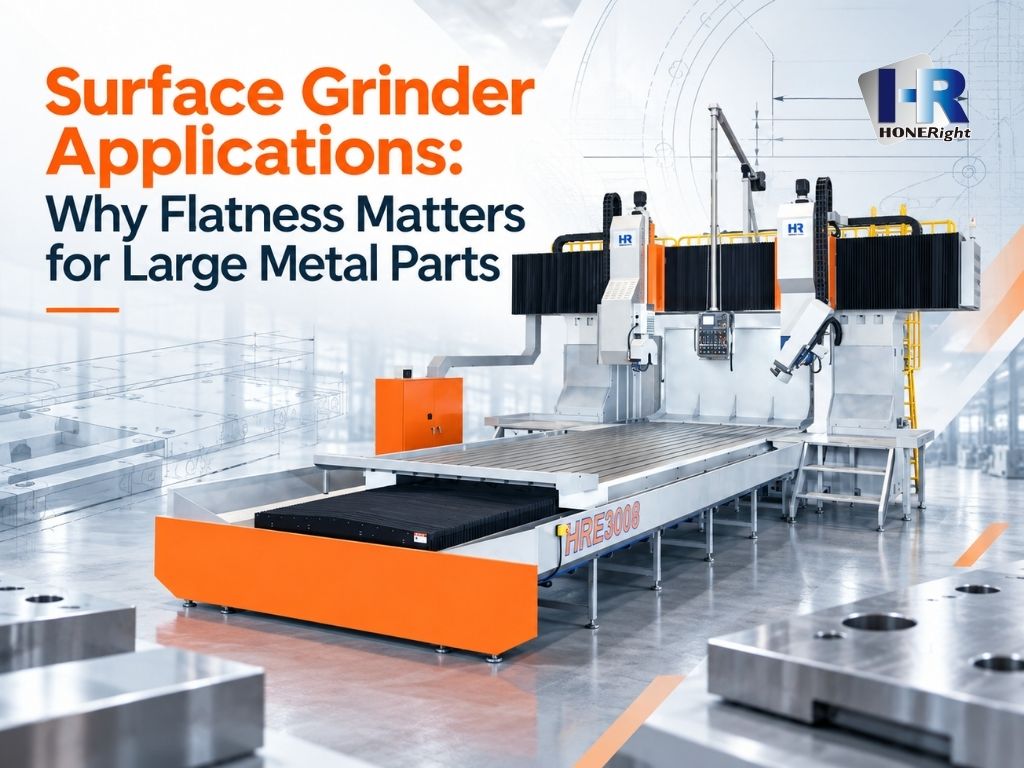
In precision metalworking, flatness is more than a dimensional requirement. For large metal parts, it can directly affect assembly accuracy, machine stability, contact performance, sealing quality, and long-term reliability. When a part is large, heavy, or difficult to reposition, even small surface errors can create problems during assembly or final operation.
This is why surface grinding plays an important role in many industrial manufacturing processes.
A surface grinder is used to create flat, smooth, and accurate surfaces on metal workpieces. For large plates, mold bases, machine beds, structural components, and heavy-duty parts, manufacturers often need more than a conventional surface grinder. They may require a double column surface grinder, also known as a gantry surface grinder or bridge-type surface grinder, to support larger workpieces and maintain stable grinding performance across a wider area.
This article explains why flatness matters for large metal parts, where surface grinders are commonly used, and how the right grinding solution can help manufacturers improve quality and production reliability.
Table of Contents
- Why Flatness Matters in Large Metal Parts
- How Surface Grinding Improves Flatness and Surface Quality
- Common Surface Grinder Applications
- Application 1: Mold Bases and Die Components
- Application 2: Machine Beds and Structural Components
- Application 3: Large Metal Plates and Base Plates
- Application 4: Heavy Equipment and Industrial Parts
- Application 5: Precision Fixtures and Assembly Surfaces
- When Is a Double Column Surface Grinder Needed?
- Key Factors That Affect Flatness in Surface Grinding
- Hone Right Surface Grinding Solutions
- FAQ: Surface Grinder Applications and Flatness
- Conclusion
- Related Articles
Why Flatness Matters in Large Metal Parts
Flatness is the condition of a surface being even across its working area. For small parts, minor surface variation may sometimes be corrected during assembly. However, for large metal parts, poor flatness can create more serious problems because the contact area is larger and the workpiece is usually heavier.
When a large component is not flat enough, it may not sit properly against another part. This can lead to unstable assembly, uneven load distribution, vibration, alignment errors, or reduced machine performance. In some applications, poor flatness may also affect sealing, sliding movement, or long-term wear.
For manufacturers, flatness is not only about surface appearance. It is closely related to how the part functions after installation.
How Surface Grinding Improves Flatness and Surface Quality
Surface grinding improves flatness by removing small amounts of material from the workpiece surface with a rotating abrasive wheel. The goal is to create a flatter, smoother, and more consistent surface compared with rough machining or untreated material.
In many production workflows, surface grinding is performed after milling, welding, casting, heat treatment, or rough machining. These previous processes may leave uneven surfaces, stress-related distortion, machining marks, or dimensional variation. Surface grinding helps correct these issues and prepares the workpiece for assembly or further processing.
For large parts, surface grinding can help improve:
- Flatness across a broad surface
- Surface finish and smoothness
- Thickness consistency
- Contact accuracy
- Assembly reliability
- Long-term operating stability
A stable surface grinding process is especially important when the part must support another component, move against another surface, or maintain precision during machine operation.
Common Surface Grinder Applications
Surface grinders are used in many industries because flat surfaces are required in a wide range of metal components. The application may vary, but the core purpose is often the same: to create a stable and accurate surface that supports the function of the final product.
Common surface grinder applications include:
- Mold bases
- Die plates
- Machine beds
- Machine columns
- Base plates
- Large metal plates
- Precision fixtures
- Industrial frames
- Heavy-duty components
- Structural metal parts
For small and medium-sized workpieces, a conventional surface grinder may be enough. For larger or heavier parts, a double column surface grinder is often more suitable because it provides a wider working area and stronger structural support.
Application 1: Mold Bases and Die Components
Mold bases and die components often require high flatness because they must support accurate assembly and repeatable production. If the surface is uneven, the mold may not close properly, alignment may be affected, or final product quality may become unstable.
In mold and die manufacturing, surface grinding is used to improve the flatness of plates, bases, inserts, and contact surfaces. A smooth and accurate surface helps ensure that the mold structure fits together correctly.
For larger mold bases, stable grinding is especially important. The workpiece may be too heavy or too wide for a standard machine, and repeated handling can increase the risk of positioning error. A double column surface grinder can help support large mold components more effectively during grinding.
Application 2: Machine Beds and Structural Components
Machine beds, tables, columns, and structural components often serve as the foundation of larger equipment. If these parts are not flat or stable enough, the performance of the final machine may be affected.
For example, a machine bed must provide a stable base for moving components. Poor flatness may lead to misalignment, uneven motion, vibration, or accuracy problems during operation. Because machine structures often support high loads and repeated movement, surface quality and flatness are critical.
Surface grinding helps manufacturers improve the flat contact areas of machine components. For large machine beds or structural parts, a double column surface grinder provides the working capacity and rigidity needed to process wide surfaces more consistently.
Application 3: Large Metal Plates and Base Plates
Large metal plates and base plates are used in many industrial applications, including machinery, equipment foundations, fixtures, and welded assemblies. These plates may need surface grinding to improve flatness before installation or further machining.
If a base plate is uneven, the parts mounted on it may not align properly. Uneven surfaces can also create gaps, stress concentration, or unstable contact between assembled components. In some cases, this may lead to vibration, premature wear, or assembly failure.
Surface grinding can help correct surface variation and improve the plate’s usability as a reliable mounting or support surface. For oversized plates, using a machine with sufficient table size and stable structure is essential.
Application 4: Heavy Equipment and Industrial Parts
Heavy equipment components often require strong, stable, and accurate contact surfaces. These parts may be used in construction machinery, industrial machinery, manufacturing equipment, energy-related equipment, or other heavy-duty applications.
Because these components are usually large and heavy, they may be difficult to move or reposition. Every additional setup can increase time, cost, and the risk of handling damage. Surface grinding on a stable machine helps reduce repeated handling while improving surface accuracy.
For heavy-duty parts, flatness can influence load distribution. If the surface is uneven, force may concentrate in certain areas, increasing the risk of wear or deformation over time.
Application 5: Precision Fixtures and Assembly Surfaces
Precision fixtures are used to hold, locate, or support workpieces during production. If the fixture surface is not flat, every part placed on it may be affected. This can reduce repeatability and make production quality harder to control.
Surface grinding is commonly used to improve fixture surfaces, reference planes, and assembly contact surfaces. A flatter surface helps ensure that parts are positioned consistently and that measurement or machining results remain more stable.
This is especially important in precision metalworking, where small surface errors can affect the accuracy of later processes.
When Is a Double Column Surface Grinder Needed?
A double column surface grinder is needed when a conventional surface grinder cannot provide enough working area, load capacity, or structural rigidity for the workpiece. This often happens when the part is large, heavy, wide, or difficult to reposition.
Manufacturers should consider a double column surface grinder when:
- The workpiece is too large for a standard surface grinder
- The workpiece weight requires stronger machine support
- Flatness must be maintained across a wide area
- The part is difficult to lift, move, or reposition
- The surface is used for precision assembly or machine stability
- Production requires consistent results for heavy-duty parts
The double column structure provides stronger support for wide grinding applications. It also helps maintain stability during machining, which is important for large workpieces that are more sensitive to vibration and deflection.
Key Factors That Affect Flatness in Surface Grinding
Flatness is influenced by several factors during surface grinding. The machine structure, workpiece setup, grinding parameters, material condition, and operator experience can all affect the final result.
| Factor | Why It Matters |
|---|---|
| Machine rigidity | Helps reduce vibration and structural deflection during grinding |
| Worktable support | Supports large or heavy workpieces more evenly |
| Workpiece setup | Helps reduce positioning errors and uneven contact |
| Grinding wheel selection | Affects material removal, heat generation, and surface finish |
| Grinding parameters | Influence cutting stability, accuracy, and surface quality |
| Material condition | Heat treatment, welding, or casting stress may affect flatness |
| Operator experience | Helps optimize setup, grinding depth, and finishing process |
For large parts, these factors become even more important because the grinding area is wider and the workpiece may be more difficult to control. A stable surface grinding machine and proper setup process help manufacturers achieve better consistency.
Hone Right Surface Grinding Solutions
Hone Right provides surface grinding machine solutions for manufacturers that process large and heavy metal parts. With double column surface grinder series such as HRE Series and TG Series, Hone Right supports surface grinding applications for large plates, mold bases, machine beds, structural components, and other heavy-duty workpieces.
For customers who need reliable flatness, smoother surface finish, and stable grinding performance, choosing the right machine is essential. Hone Right also provides consultation and service support to help manufacturers evaluate suitable grinding equipment according to workpiece size, application needs, and production goals.
FAQ: Surface Grinder Applications and Flatness
1. Why is flatness important for large metal parts?
Flatness is important because large metal parts often serve as mounting surfaces, contact surfaces, machine structures, or assembly bases. If the surface is uneven, it may cause poor alignment, unstable assembly, vibration, uneven load distribution, or reduced long-term machine performance.
2. What types of large metal parts commonly require surface grinding?
Surface grinding is commonly used for mold bases, die plates, machine beds, base plates, precision fixtures, structural components, and heavy-duty industrial parts. These components often require accurate flatness to support assembly, positioning, sliding, or load-bearing performance.
3. When is a double column surface grinder more suitable than a conventional surface grinder?
A double column surface grinder is more suitable when the workpiece is large, heavy, or requires stable grinding across a wide surface. Compared with a conventional surface grinder, it provides stronger structural support, larger working capacity, and better stability for large flat workpieces.
4. What factors affect flatness during surface grinding?
Flatness can be affected by machine rigidity, workpiece setup, table support, grinding wheel selection, grinding parameters, material condition, and operator experience. For large metal parts, machine stability and proper support are especially important because the grinding area is wider and the workpiece is harder to control.
Conclusion
Flatness is a critical requirement for many large metal parts. Whether the component is a mold base, machine bed, base plate, precision fixture, or heavy-duty structural part, its surface condition can directly affect assembly accuracy, stability, and long-term performance.
Surface grinding helps manufacturers improve flatness, surface finish, and dimensional consistency. For smaller workpieces, a standard surface grinder may be sufficient. For large, heavy, or wide workpieces, a double column surface grinder provides the structure and support needed for more stable grinding.
By understanding the applications of surface grinders and the role of flatness in large metal parts, manufacturers can choose a more suitable grinding solution and improve both production quality and reliability.
Related Articles
To learn more about grinding machines and large workpiece machining, you may also be interested in the following articles:
Looking for Surface Grinding Solutions for Large Metal Parts?
If your production involves large plates, mold bases, machine beds, structural components, or heavy-duty metal parts, choosing the right surface grinding machine can directly affect flatness, surface quality, and machining stability.
Hone Right provides double column surface grinder solutions for large workpieces and heavy-duty surface grinding applications. Contact Hone Right to discuss your workpiece size, grinding requirements, and production goals.