Grinding machines are essential equipment in precision metalworking. After cutting, milling, turning, welding, or heat treatment, many metal components still require grinding to achieve better surface finish, tighter dimensional accuracy, or improved flatness.
However, not all grinding machines are designed for the same purpose. Some machines are used for round parts, some are used for internal bores, and others are designed for flat surfaces or large workpieces. For manufacturers, choosing the wrong type of grinding machine can lead to poor efficiency, unstable quality, or unnecessary production costs.
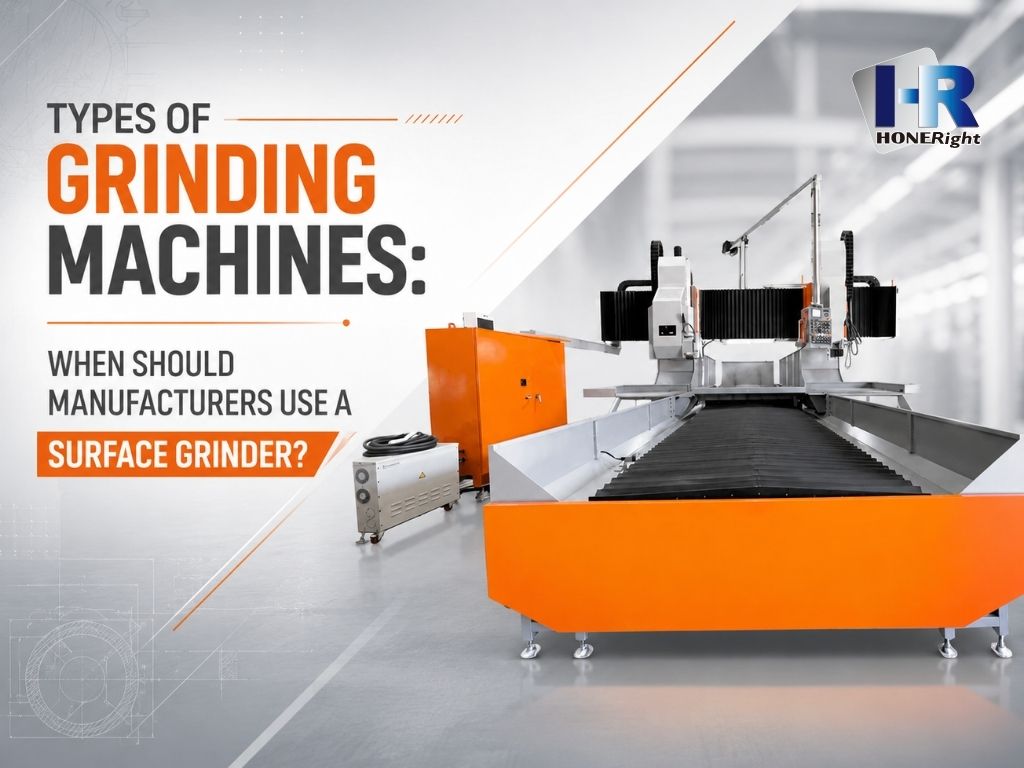
Among different types of grinding machines, the surface grinder is mainly used for flat surface finishing. When the workpiece becomes larger, heavier, or requires grinding across a wide surface, manufacturers may need a double column surface grinder, also known as a gantry surface grinder or bridge-type surface grinder.
This article explains the common types of grinding machines, how they differ, and when manufacturers should use a surface grinder for flat metal parts.
Table of Contents
- What Are Grinding Machines?
- Common Types of Grinding Machines
- Grinding Machine Comparison Table
- How to Choose the Right Grinding Machine by Workpiece Shape
- When Should Manufacturers Use a Surface Grinder?
- When Is a Double Column Surface Grinder Needed?
- Surface Grinding vs. Other Grinding Processes
- Applications of Surface Grinding Machines
- Hone Right Surface Grinding Solutions
- FAQ: Grinding Machines and Surface Grinders
- Conclusion
What Are Grinding Machines?
Grinding machines are machine tools that use abrasive wheels to remove material from a workpiece. Compared with cutting tools that remove larger chips, grinding removes smaller amounts of material with higher precision.
Manufacturers use grinding machines when a workpiece requires better surface quality, tighter tolerance, accurate shape control, or final finishing after machining. Grinding is commonly used after milling, turning, casting, welding, or heat treatment.
Typical grinding requirements include:
- Surface finish improvement
- Flatness correction
- Thickness control
- Roundness improvement
- Inner diameter finishing
- Final precision finishing before assembly
Common Types of Grinding Machines
Different grinding machines are designed for different workpiece shapes and production needs. Understanding these differences helps manufacturers select the right equipment before investing in a machine.
Surface Grinding Machine
A surface grinding machine is used to create flat, smooth, and accurate surfaces on metal workpieces. The workpiece is usually fixed on a table, while a rotating grinding wheel removes material from the surface.
Surface grinding machines are commonly used for:
- Metal plates
- Mold bases
- Machine components
- Precision fixtures
- Mounting surfaces
- Tooling and die components
This type of grinding machine is suitable when the main requirement is flatness, surface finish, and controlled material removal on a flat surface.
Cylindrical Grinding Machine
A cylindrical grinding machine is used for grinding the outside diameter of round workpieces. During grinding, the workpiece rotates while the grinding wheel removes material from the outer surface.
Cylindrical grinding is commonly used for:
- Shafts
- Pins
- Rollers
- Bushings
- Round machine components
- Precision cylindrical parts
This machine type is suitable when the workpiece requires accurate roundness, diameter control, and smooth outer surfaces.
Centerless Grinding Machine
A centerless grinding machine is used for grinding round workpieces without holding them between centers. The workpiece is supported by a work rest blade and controlled by a regulating wheel and grinding wheel.
Centerless grinding is often used for high-volume production of round parts, such as:
- Bars
- Pins
- Tubes
- Small shafts
- Automotive components
- Precision round stock
This process is efficient for continuous production, especially when many similar round parts need to be processed.
Internal Grinding Machine
An internal grinding machine is used to grind the inner diameter of holes or bores. The grinding wheel works inside the workpiece to improve internal accuracy and surface finish.
Internal grinding is commonly used for:
- Bearings
- Bushings
- Sleeves
- Hydraulic components
- Precision bores
- Internal cylindrical surfaces
This machine type is suitable when the key requirement is inner diameter accuracy rather than external surface finishing.
Tool and Cutter Grinder
A tool and cutter grinder is used to sharpen, recondition, or manufacture cutting tools. It can process complex tool geometries and cutting edges.
Common applications include:
- End mills
- Drills
- Reamers
- Milling cutters
- Custom cutting tools
- Form tools
This machine type is usually used in toolrooms, cutting tool production, and maintenance operations.
Double Column Surface Grinder
A double column surface grinder is a heavy-duty type of surface grinding machine designed for large and heavy workpieces. It uses two vertical columns and a crossbeam structure to support the grinding head and maintain rigidity over a wide working area.
This type of machine is commonly used for:
- Large plates
- Mold bases
- Machine beds
- Structural components
- Heavy-duty metal parts
- Large precision surfaces
Compared with a conventional surface grinder, a double column surface grinder provides a larger working range, stronger structural support, and better stability for heavy workpieces.
Grinding Machine Comparison Table
| Grinding Machine Type | Main Workpiece Shape | Main Purpose | Suitable Applications |
|---|---|---|---|
| Surface Grinding Machine | Flat surfaces | Flatness and surface finish | Plates, mold bases, fixtures, machine parts |
| Cylindrical Grinding Machine | Round outer surfaces | Diameter accuracy and roundness | Shafts, rollers, pins, bushings |
| Centerless Grinding Machine | Round parts | Efficient volume production | Bars, tubes, pins, small shafts |
| Internal Grinding Machine | Internal holes or bores | Inner diameter accuracy | Bearings, sleeves, hydraulic parts |
| Tool and Cutter Grinder | Cutting tools | Tool sharpening and tool geometry | Drills, end mills, cutters |
| Double Column Surface Grinder | Large flat surfaces | Heavy-duty surface grinding | Large plates, machine beds, mold bases |
How to Choose the Right Grinding Machine by Workpiece Shape
The easiest way to choose the right grinding machine is to start with the workpiece shape.
If the part has a flat surface that requires better flatness or surface finish, a surface grinding machine is usually the correct choice. If the part is round and requires outside diameter control, a cylindrical grinder or centerless grinder may be more suitable. If the part has an internal bore that needs precision finishing, an internal grinder should be considered.
For large flat workpieces, such as mold bases, machine beds, base plates, or heavy structural parts, a double column surface grinder is often more suitable than a conventional surface grinder because it provides better support and stability.
| Workpiece Requirement | Recommended Grinding Machine |
|---|---|
| Flat surface finishing | Surface grinding machine |
| Large flat metal parts | Double column surface grinder |
| Round outside diameter | Cylindrical grinding machine |
| High-volume round parts | Centerless grinding machine |
| Internal hole or bore finishing | Internal grinding machine |
| Cutting tool sharpening | Tool and cutter grinder |
When Should Manufacturers Use a Surface Grinder?
Manufacturers should use a surface grinder when the workpiece requires a flat, smooth, and accurate surface. In industrial applications, surface quality is not only about appearance. It can directly affect assembly accuracy, machine performance, sliding movement, sealing, and long-term reliability.
A surface grinder is suitable when the part has:
- A flat contact surface
- A mounting surface
- A sliding surface
- A mold or die surface
- A precision assembly surface
- A surface requiring thickness control
For example, if a machine component needs to sit accurately against another part, the contact surface must be flat. If a mold base is not properly ground, assembly accuracy and final product quality may be affected. If a sliding surface is uneven, friction and wear may increase.
Surface grinding helps manufacturers achieve better flatness, more consistent surface finish, and more reliable assembly conditions.
When Is a Double Column Surface Grinder Needed?
A conventional surface grinder may be suitable for smaller parts. However, when the workpiece becomes larger, heavier, or more difficult to control, a double column surface grinder becomes a better solution.
Manufacturers should consider a double column surface grinder when:
- The workpiece is too large for a conventional surface grinder
- The workpiece is heavy and requires strong table support
- The grinding area is wide or long
- Flatness must be maintained across a large surface
- The part is difficult to reposition
- Stable grinding performance is required for heavy-duty applications
Large metal parts are more sensitive to vibration, handling errors, and structural deflection. Every time a large workpiece is moved or repositioned, there is a risk of accumulated error. A double column surface grinder allows large parts to be processed more stably and efficiently in one setup.
This makes it suitable for mold manufacturing, machine tool manufacturing, heavy equipment components, and large precision metalworking applications.
Surface Grinding vs. Other Grinding Processes
The main difference between surface grinding and other grinding processes is the type of surface being processed.
Surface grinding focuses on flat surfaces. Cylindrical grinding focuses on round outside diameters. Internal grinding focuses on holes or bores. Tool grinding focuses on cutting tool edges and tool geometry.
This means manufacturers should not choose a grinding machine based only on the general term “grinding machine.” They should first define the workpiece shape and the required result.
If the part requires a precise flat surface, a surface grinder is usually the correct choice. If the part is round, cylindrical grinding or centerless grinding may be more suitable. If the part has internal bores, internal grinding is more appropriate.
For large flat workpieces, a double column surface grinder provides the structure and capacity required for stable results.
Applications of Surface Grinding Machines
Surface grinding machines are widely used across industries because many manufactured parts require accurate flat surfaces.
Common applications include:
- Mold and die manufacturing
- Machine tool components
- Precision metal plates
- Industrial fixtures
- Heavy equipment parts
- Base plates and mounting surfaces
- Large mechanical components
In mold and die production, surface grinding helps ensure that mold bases and related components fit together accurately. In machine tool manufacturing, flat and stable surfaces are essential for machine beds, tables, and structural parts. In heavy equipment manufacturing, large parts may require grinding to improve contact surfaces and assembly reliability.
For manufacturers working with large or heavy parts, surface grinding is often a key process for maintaining product quality.
Hone Right Surface Grinding Solutions
Hone Right provides grinding machine solutions for manufacturers that require stable and precise surface grinding. With double column surface grinder series such as HRE Series and TG Series, Hone Right supports large workpiece grinding, heavy-duty metalworking, mold base grinding, machine component grinding, and other precision surface finishing applications.
For manufacturers that need to process large plates, mold bases, machine beds, or heavy structural components, selecting the right surface grinding machine can improve machining consistency, reduce handling errors, and support better production efficiency.
Hone Right also provides professional consultation and service support to help customers evaluate suitable equipment based on workpiece size, grinding requirements, and production needs.
FAQ: Grinding Machines and Surface Grinders
1. What type of grinding machine is used for flat surfaces?
A surface grinding machine is used for flat surfaces. It removes material from the workpiece surface to improve flatness, surface finish, and dimensional accuracy. For large or heavy flat workpieces, a double column surface grinder may be more suitable.
2. What is the difference between surface grinding and cylindrical grinding?
Surface grinding is used for flat surfaces, while cylindrical grinding is used for round outside diameters. If the workpiece is a plate, mold base, or flat machine component, surface grinding is usually more suitable. If the workpiece is a shaft, roller, or pin, cylindrical grinding is usually used.
3. When should manufacturers use a double column surface grinder?
Manufacturers should use a double column surface grinder when the workpiece is large, heavy, or requires stable grinding across a wide surface. It is suitable for large plates, mold bases, machine beds, and heavy-duty precision components.
4. How do manufacturers decide which grinding machine to use?
Manufacturers should first identify the workpiece shape and required machining result. Flat surfaces usually require surface grinding, round outer surfaces require cylindrical or centerless grinding, internal bores require internal grinding, and cutting tools require tool and cutter grinding.
Conclusion
Grinding machines are important tools for precision metalworking, but different grinding machines serve different purposes. Surface grinders are used for flat surfaces, cylindrical grinders are used for round parts, internal grinders are used for bores, and tool grinders are used for cutting tools.
For manufacturers that need to process flat metal surfaces, a surface grinding machine is often the most suitable solution. When the workpiece is large, heavy, or requires stable grinding across a wide area, a double column surface grinder provides the structure, rigidity, and capacity needed for better results.
By understanding the different types of grinding machines and their applications, manufacturers can choose equipment more accurately and improve surface quality, machining consistency, and production efficiency. For large surface grinding applications, Hone Right’s double column surface grinder solutions can help manufacturers achieve stable and reliable grinding performance.
Looking for Surface Grinding Solutions for Large Workpieces?
If your production involves large plates, mold bases, machine beds, or heavy-duty metal parts, choosing the right surface grinding machine can directly affect flatness, surface finish, and long-term machining stability.
Hone Right provides double column surface grinder solutions for large workpieces and heavy-duty surface grinding applications. Contact Hone Right to discuss your workpiece size, grinding requirements, and production goals.