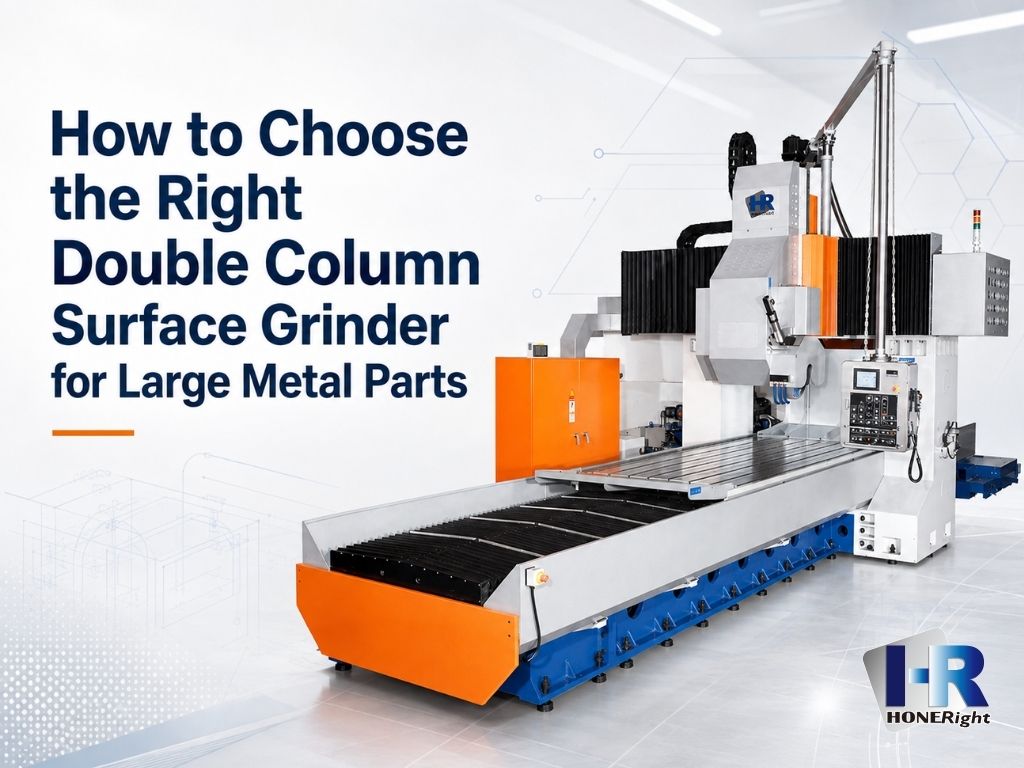
Choosing the right grinding machine is an important decision for manufacturers that work with large metal parts. When workpieces become wider, longer, heavier, or more difficult to control, a standard surface grinder may no longer provide enough stability, travel range, or load capacity. In these situations, a double column surface grinder becomes a practical solution for improving flatness, surface finish, and machining consistency.
A double column surface grinder, also known as a gantry grinder or bridge grinder, is designed with two vertical columns and a crossbeam structure. This structure helps support the grinding head and maintain rigidity during the grinding process. For large plates, mold bases, machine beds, structural components, and other heavy-duty workpieces, this machine type can help manufacturers achieve more stable and accurate surface grinding.
However, not every double column surface grinder is suitable for every application. The right machine should be selected based on workpiece size, weight, required accuracy, production volume, machine rigidity, control system, and long-term service support. This article explains the key factors manufacturers should consider before choosing a double column surface grinder for large metal parts.
Table of Contents
- Why Large Metal Parts Require a Different Grinding Solution
- Confirm the Maximum Workpiece Size
- Check Workpiece Weight and Table Load Capacity
- Define the Required Flatness and Surface Finish
- Evaluate Machine Rigidity and Structural Stability
- Consider Grinding Wheel and Spindle Performance
- Review Control System and Operation Convenience
- Match the Machine to Your Industry Application
- Consider Production Volume and Long-Term Efficiency
- Do Not Ignore Maintenance and Service Support
- Selection Checklist for Double Column Surface Grinders
- Hone Right Double Column Surface Grinder Solutions
- FAQ: Choosing a Double Column Surface Grinder
- Conclusion
Why Large Metal Parts Require a Different Grinding Solution
Large metal parts are more challenging to grind than small components. The larger the workpiece, the more difficult it becomes to maintain consistent flatness across the entire surface. Even small vibration, table movement error, or machine deflection may result in uneven grinding marks, poor surface finish, or dimensional variation.
Weight is another major concern. Heavy metal parts place more load on the machine table and guideway system. If the machine structure is not strong enough, the grinding process may become unstable. In some cases, insufficient machine rigidity can also increase wear on machine components and reduce long-term accuracy.
Large workpieces are also more difficult to reposition. Every time a part is moved, lifted, aligned, or clamped again, there is a risk of handling damage or accumulated positioning error. A properly selected double column surface grinder can help reduce unnecessary workpiece movement and allow more grinding work to be completed in one setup.
For these reasons, choosing a double column surface grinder is not only about buying a larger machine. It is about selecting a machine structure that can support the real machining conditions in your factory.
1. Confirm the Maximum Workpiece Size
The first factor to consider is the maximum workpiece size. Manufacturers should carefully check the length, width, and height of the parts they need to grind. The machine table must be large enough to support the workpiece, while the grinding travel must be sufficient to cover the entire machining area.
When evaluating workpiece size, do not only consider the largest part you are grinding today. You should also think about future production needs. If your company may receive larger mold bases, longer plates, or bigger machine components in the future, choosing a machine with slightly more capacity can provide better long-term flexibility.
It is also important to consider loading and unloading space. Large metal parts often require cranes, forklifts, or other lifting equipment. The machine layout should allow operators to place and remove workpieces safely without interfering with surrounding equipment.
A machine that is too small may limit production capability. A machine that is too large may increase cost and floor space requirements. The best choice is a machine that matches your actual workpiece range while leaving reasonable room for future demand.
2. Check Workpiece Weight and Table Load Capacity
For large metal parts, weight can be just as important as size. A wide workpiece may not be suitable for grinding if the machine table cannot safely support its weight. Before selecting a double column surface grinder, manufacturers should confirm the maximum workpiece weight and compare it with the machine’s table load capacity.
Heavy workpieces can affect table movement, guideway stability, and grinding accuracy. If the load exceeds the machine’s design capacity, the machine may experience poor motion accuracy, increased vibration, or long-term structural stress.
Manufacturers should also consider how the weight is distributed. A workpiece may be within the maximum load limit, but if the weight is concentrated in one area, it may still affect table balance and machining stability. This is especially important for irregular parts, thick plates, castings, or welded structures.
For this reason, manufacturers should provide the machine supplier with actual workpiece drawings, dimensions, weight, and loading conditions whenever possible. This allows the supplier to recommend a more suitable machine configuration.
3. Define the Required Flatness and Surface Finish
Not all grinding jobs require the same accuracy. Some large metal parts only need general surface cleanup, while others require strict flatness, parallelism, thickness control, or surface finish. Before choosing a double column surface grinder, manufacturers should define their required quality standards clearly.
Flatness is especially important for mold bases, machine tool components, sliding surfaces, and assembly surfaces. If the ground surface is not flat enough, the final product may suffer from poor contact, alignment problems, vibration, or reduced service life.
Surface finish is also important. A smooth and consistent surface may be required for precision assembly, sealing, sliding movement, or further processing. In these applications, grinding is not simply a finishing step; it directly affects the performance of the final component.
When discussing machine selection with a supplier, manufacturers should not only say that they need “high precision.” It is better to provide specific tolerance requirements, surface roughness targets, material type, and current grinding challenges. This makes it easier to evaluate whether the machine can meet the required performance.
4. Evaluate Machine Rigidity and Structural Stability
Machine rigidity is one of the most important factors in heavy-duty surface grinding. A double column surface grinder is designed to provide strong support through two vertical columns and a crossbeam. This structure helps reduce deflection and supports stable grinding movement across a wide working area.
For large metal parts, rigidity affects both accuracy and surface quality. If the machine structure is not stable enough, vibration may appear during grinding. This can cause poor surface finish, grinding marks, inconsistent flatness, and shorter grinding wheel life.
The machine bed, columns, crossbeam, table, guideways, and grinding head all contribute to overall rigidity. When evaluating a machine, manufacturers should consider the complete structure rather than focusing only on table size.
A rigid machine also helps improve repeatability. In production environments where similar large parts are processed repeatedly, stable machine structure allows manufacturers to maintain more consistent results over time.
5. Consider Grinding Wheel and Spindle Performance
The grinding wheel and spindle system play a major role in grinding quality. For large metal parts, the machine must be able to remove material efficiently while maintaining smooth operation. If the spindle lacks stability or the grinding wheel is not suitable for the material, the grinding result may be inconsistent.
Different workpiece materials may require different grinding wheels, wheel speeds, and grinding parameters. For example, cast iron, steel plates, mold materials, and welded structures may each behave differently during grinding. The machine should allow operators to adjust grinding conditions according to the application.
Spindle stability is also important for surface finish. A high-quality spindle helps reduce vibration and supports smoother grinding performance. For manufacturers that require fine surface finishing or strict flatness, spindle performance should not be overlooked.
Before purchasing a machine, it is useful to discuss common materials, grinding depth, removal rate, and surface finish goals with the supplier. This helps determine whether the machine configuration is suitable for your actual production needs.
6. Review Control System and Operation Convenience
Modern double column surface grinders may include different levels of control functions depending on the machine model and application. For large workpieces, operation convenience can significantly affect production efficiency.
A user-friendly control system helps operators set grinding parameters, adjust travel movement, and manage grinding cycles more easily. This is especially valuable when processing workpieces with different sizes or when the factory handles high-mix production.
Operation convenience also includes machine accessibility. Operators should be able to load parts, set up the workpiece, check grinding conditions, and perform maintenance without unnecessary difficulty. For large machines, poor accessibility can increase setup time and reduce efficiency.
Manufacturers should consider the skill level of their operators as well. A machine that is too complicated may require longer training, while a machine with clear controls and practical functions can help improve daily productivity.
7. Match the Machine to Your Industry Application
Different industries may use double column surface grinders for different purposes. Mold and die manufacturers often focus on flatness, surface finish, and dimensional consistency. Machine tool manufacturers may require stable grinding for machine beds, tables, columns, and structural components. Heavy equipment manufacturers may need to process large plates, frames, and other load-bearing parts.
Because each application has different requirements, the machine should be selected according to the real production environment. A factory producing precision mold bases may prioritize surface accuracy and finish. A factory processing heavy industrial parts may focus more on load capacity, rigidity, and material removal efficiency.
This is why application discussion is important before purchasing. Manufacturers should explain what types of parts they grind, what materials they use, how often they process large workpieces, and what problems they face with their current equipment.
A good machine selection process should start from the part, not only from the machine catalog.
8. Consider Production Volume and Long-Term Efficiency
Production volume also affects machine selection. Some manufacturers only need to grind large workpieces occasionally, while others need continuous grinding capacity for daily production. The right machine should match both current workload and future growth.
For low-volume production, flexibility and setup convenience may be more important. For higher-volume production, cycle efficiency, machine durability, repeatability, and maintenance planning become more critical.
Large workpieces often require more time for loading, alignment, clamping, grinding, inspection, and unloading. A machine that improves setup efficiency and reduces repeated handling can create meaningful time savings over the long term.
Manufacturers should evaluate the total production process, not only the grinding cycle itself. A suitable double column surface grinder can help reduce bottlenecks, improve workflow, and increase overall production reliability.
9. Do Not Ignore Maintenance and Service Support
A double column surface grinder is a long-term investment. Beyond the machine’s technical specifications, manufacturers should also evaluate maintenance requirements and service support.
Heavy-duty grinding machines operate under demanding conditions. Regular maintenance is necessary to keep the machine stable and accurate. Guideways, lubrication systems, grinding spindle, table movement, control components, and coolant systems should all be maintained properly.
Service support is especially important for large machines. If a machine problem occurs, downtime can affect production schedules and customer delivery. A supplier that provides professional consultation, installation support, maintenance assistance, and repair service can help reduce long-term risk.
For this reason, manufacturers should consider both machine performance and supplier support before making a final decision. A reliable machine supplier can help customers select suitable equipment, plan installation, and maintain stable machine performance over time.
Selection Checklist for Double Column Surface Grinders
| Selection Factor | What to Check | Why It Matters |
|---|---|---|
| Workpiece size | Length, width, height, and grinding area | Ensures the machine has enough table size and travel range |
| Workpiece weight | Maximum load and weight distribution | Prevents overload and supports stable grinding |
| Accuracy requirement | Flatness, thickness tolerance, parallelism | Helps match the machine to quality requirements |
| Surface finish | Required smoothness and surface condition | Affects assembly, sliding, sealing, and product performance |
| Machine rigidity | Bed, columns, crossbeam, table, and grinding head | Reduces vibration and improves grinding consistency |
| Material type | Steel, cast iron, mold material, welded structure | Helps determine grinding wheel and process settings |
| Production volume | Occasional use or continuous production | Affects machine durability and efficiency needs |
| Service support | Installation, maintenance, repair, consultation | Protects long-term machine value and reduces downtime |
Hone Right Double Column Surface Grinder Solutions
Hone Right provides double column surface grinder solutions for manufacturers that need stable surface grinding for large and heavy metal parts. The product lineup includes Double Column Surface Grinder HRE Series and Double Column Surface Grinder TG Series, supporting different surface grinding requirements for large workpieces and heavy-duty metalworking applications.
For manufacturers processing large plates, mold bases, machine components, structural parts, or heavy-duty metal workpieces, choosing the right grinder can directly affect machining quality and production efficiency. Hone Right supports customers with product options, technical consultation, and service support to help them select suitable equipment based on real workpiece conditions.
FAQ: Choosing a Double Column Surface Grinder
1. What is the most important factor when choosing a double column surface grinder?
The most important factor is whether the machine can support your actual workpiece size, weight, and accuracy requirements. A machine should not be selected by table size alone. Manufacturers should also consider load capacity, rigidity, grinding travel, surface finish requirements, and long-term service support.
2. Is a double column surface grinder only for very large parts?
A double column surface grinder is mainly designed for large or heavy parts, but it is also useful when high stability is required across a wide grinding area. Even if the workpiece is not extremely large, manufacturers may choose this machine type when flatness and surface consistency are critical.
3. How does machine rigidity affect grinding quality?
Machine rigidity helps reduce vibration, deflection, and movement errors during grinding. Better rigidity allows the machine to maintain more stable contact between the grinding wheel and the workpiece, which supports better flatness, smoother surface finish, and more consistent results.
4. What information should I provide before asking for a machine recommendation?
It is helpful to provide workpiece drawings, dimensions, weight, material type, required flatness, surface finish target, production volume, and current grinding problems. The more complete the information, the easier it is to recommend a suitable machine.
5. Can one double column surface grinder handle different types of workpieces?
Yes, many manufacturers use double column surface grinders for different large metal parts. However, the machine must have enough capacity, suitable grinding performance, and flexible operation settings to handle different materials, sizes, and accuracy requirements.
6. Why should after-sales service be considered before purchasing?
After-sales service affects long-term machine performance and production stability. Installation support, operator guidance, maintenance service, and repair capability can help reduce downtime and keep the machine operating reliably over time.
Conclusion
Choosing the right double column surface grinder for large metal parts requires a careful review of workpiece size, weight, accuracy, surface finish, machine rigidity, grinding performance, operation convenience, and service support. For manufacturers working with large plates, mold bases, machine tool components, and heavy-duty metal parts, the right machine can improve grinding quality, reduce handling, and support more stable production.
A double column surface grinder should not be selected only because it is larger than a conventional surface grinder. It should be selected because its structure, capacity, and performance match the real requirements of your workpieces.
If your production involves large metal parts, strict flatness requirements, or heavy-duty surface grinding, Hone Right can help you evaluate suitable double column surface grinder solutions for your application.
Need Help Choosing a Double Column Surface Grinder?
Hone Right provides double column surface grinder solutions for large metal parts, precision grinding, and heavy-duty metalworking applications. Contact us to discuss your workpiece size, grinding requirements, and production goals.